Free SMS verification sites: anyone can read your code
We examined two public US SMS inboxes. See what they expose, why apps may reject shared numbers, and what a private temporary number can actually fix.

A free SMS verification site can keep your personal phone number out of a sign-up form. But if its inbox is public, it also puts the verification message where strangers can read it. Hiding your personal number and keeping your code private are two different things.
We examined two pages labeled as US numbers on October 4, 2026. One displayed 20 messages across 12 named services. The other displayed 60 message rows, including password-recovery text and login links. Neither required us to sign in to read the page.
That answers part of “is receive SMS online safe?” A public inbox gives you no private channel for a secret. Access still depends on the app's security checks.
What we counted, and what we did not test
We fetched the original inbox HTML directly with Node, without requesting any verification codes or accessing anyone's account. We counted the message entries in that response, not a search snippet or the site's promotional claims. Observation times below use Brasília time, BRT (UTC−3).
We counted distinct names printed in message bodies. Repeated messages count as separate rows, but repeated service names count once. Different labels such as Meta and Instagram remain separate. These names do not authenticate the sender. Languages come from readable message text; corrupted text and uncertain transliteration remain unclassified.
| Observed US inbox | Observation on October 4 | Visible entries | Named services or providers | Readable languages | Date added / total advertised |
|---|---|---|---|---|---|
| TemporaryNumber, area code 360 | 07:05:32 BRT | 20 | 12 | English, Italian, Chinese (traditional characters) | September 21, 2026 / 4,892 messages |
| ReceiveSMSOnline.net, area code 864 | 07:07:10 BRT | 60 | 30 | English, Chinese, Portuguese, Spanish, Polish, Italian | Neither shown on the inbox page |
These are snapshots of what the pages published. They do not prove that every message is genuine, that the relative timestamps reflect actual delivery, or that a number will work for your app today.
One US number, 20 messages, three languages
TemporaryNumber's sample included messages naming Amazon, Roblox, BIGO LIVE, bilibili, dupe.com, SWAG, Meta, Instagram, Klover, rednote and Credit Genie. Three messages named Roblox; four named Credit Genie. Its 4,892 total was a separate counter, not the entries we inspected.
The rednote text described linking a phone number. Amazon and Instagram messages included warnings against sharing the code. Yet the page published the message bodies without a login. Those warnings did not make the inbox private.
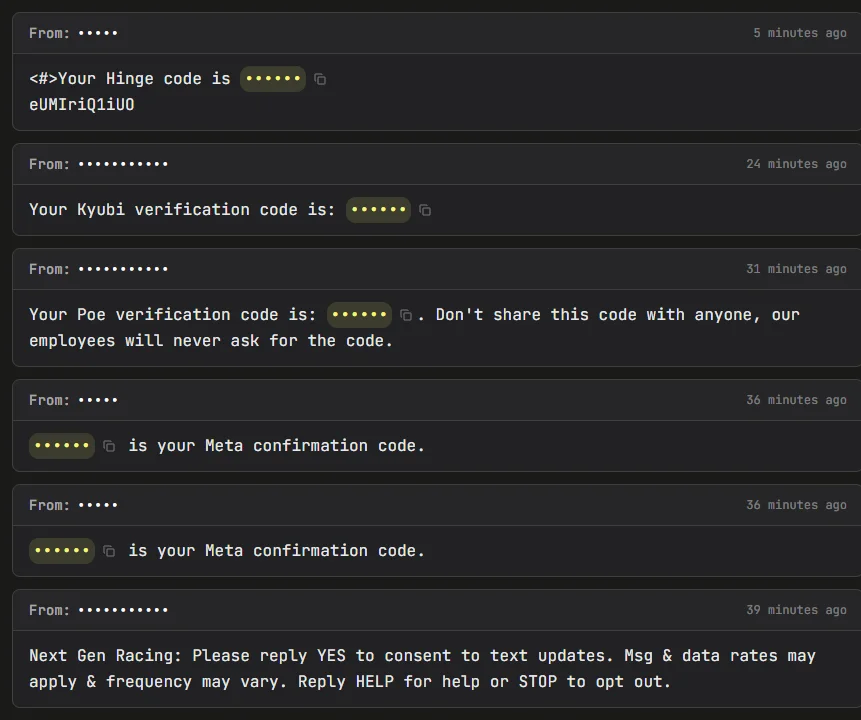 TemporaryNumber's public inbox for the same US number on October 4, 2026, at 10:02 BRT, three hours after our count. The messages had already changed. Codes and sender numbers masked by Ativa SMS before capture.

A second inbox exposed recovery messages too
ReceiveSMSOnline.net displayed 60 message rows on its US inbox page. Readable text named 30 services or providers, including Telegram, WeChat, Google, Instagram, Proton, Viber, Tinder, Yalla, Rappi and Zalo. Other entries contained corrupted characters or short test text. We did not classify those as evidence of a particular service or language.
Two entries stood out. A message labeled Yalla described retrieving a password. An Instagram-labeled entry contained a password-reset link. Telegram-labeled entries contained login links, and another mentioned canceling an account reset. We did not open any of those links. The site published more than sign-up codes: it also displayed text about recovering access.
This page showed no added date. Relative time labels cannot establish when the number went online or when messages were sent. These entries do not prove that someone reset an account that morning.
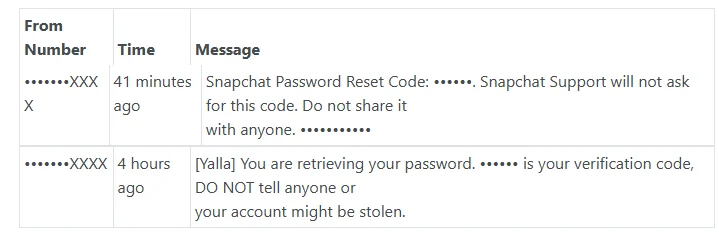 Two password-recovery messages on ReceiveSMSOnline.net's public US inbox, October 4, 2026, 10:04 BRT. Rows from the same page, shown without the advertisement between them. Codes and sender numbers masked by Ativa SMS before capture.
A page can hide your personal number while exposing an account's recovery message. “Free US number” tells you the price and the site's country label, not who can read the inbox.
What a stranger could do with an exposed code
An SMS code is meant to show control of the destination number. In a public inbox, reading the destination's messages requires no exclusive control. Anyone who opens the same page can see the same text.
If an app allows recovery through that number and accepts an SMS code as sufficient proof, a stranger could receive the recovery secret through the public page. An app might instead require a password, a trusted device, a separate PIN or other evidence. Exposure creates an opportunity; it does not establish a successful takeover.
Similarly, a shared number may already be associated with someone else's account. Successful delivery does not establish that the account is yours. If an app shows an unfamiliar account or profile, stop and use its official support process. Do not try to access it.

Today's code can expire while the page remains available to publish a future recovery message. Deleting a message cannot undo someone having read it.
Signal illustrates why extra protections matter. Its official PIN documentation describes an optional registration lock and says it expires after seven days of inactivity. The PIN is separate from the SMS registration code and is not a chat backup. A public code therefore does not automatically mean someone can read your past conversations.
Why free SMS verification sometimes fails
Seeing an Amazon-labeled message does not establish that your Amazon verification will arrive or be accepted. We measured no delivery success rate.
There is a documented reason for repeated-use errors. Google's verification help says it limits how many accounts a number can create and how many times it can be used for verification, to prevent abuse. Our inference: a widely shared number can encounter those limits because other people have used it before you.
That is different from proving that every free number appears on a universal blocklist. We did not inspect any app's private rejection list. SMSOnline.cloud itself warns that its free numbers may be blocked by some services; that is the operator's warning, not an independent acceptance test.
Line type is another possible check. For the documented mechanism, see how apps check VoIP and non-VoIP numbers. Public visibility, line classification and previous use are separate questions. Paying for an inbox does not guarantee acceptance.
What NIST actually says about SMS
NIST SP 800-63B-4, sections 3.1.3.3 and 3.2.9, classifies authentication through the public telephone network, including SMS and voice, as restricted. Restricted means it can still be used subject to additional requirements, rather than being universally prohibited.
The guidance calls for alternatives and consideration of risk indicators such as device swaps, SIM changes and number porting. It concerns digital authentication for government systems; it does not certify commercial SMS inbox sites.
Our conclusion is narrower: publishing the secret for everyone to read adds a separate exposure problem to a channel that already needs safeguards. A private temporary inbox removes public-page exposure during its reservation. It does not turn SMS into a stronger authenticator or give you lasting control of the number.

Public, private temporary, or a number you keep?
| Question | Free public inbox | Private temporary activation | Your continuing mobile line |
|---|---|---|---|
| Can other visitors read the page's messages? | Yes, in our samples | No public inbox during the reservation | No public inbox by design |
| Do you retain the number for future recovery? | No exclusive control | No, after expiry | While you maintain control of the line |
| Can an app reject it? | Yes | Yes | Acceptance still depends on the app |
| Suitable purpose | Non-sensitive testing permitted by the app | Limited SMS verification permitted by the app | Accounts you need to keep and recover |
Google's recovery guidance gives a useful standard for an account you intend to keep:
Use a mobile phone that gets text messages, belongs only to you, and that you use regularly and keep with you.
When not to use a temporary number
Use a number you maintain for bank and payment accounts, your main email, your everyday WhatsApp, and any account you will need to recover. A temporary reservation ends; it is not a future recovery channel. Adding an email or passkey does not guarantee that an app will never require the old phone number again.
Use numbers only as the app permits. Ativa SMS prohibits fraud and using its service to get around another service's terms. Read our terms of use before buying.
If you already used a public inbox
While you still have legitimate access, replace the public number in the account's official settings with one you control. Review recovery options and active sessions. Add a passkey, security key or authenticator where supported, and save the app's recovery codes privately.
Do not assume the old recovery route disappears immediately. Google says it may send codes to previous recovery information for seven days after a change. Follow the app's own instructions if you are locked out. Buying another temporary number does not recover an account tied to the old one.
When a private temporary activation fits
For a permitted verification that needs SMS, Ativa SMS reserves a number for you for up to 20 minutes. The exact deadline depends on the option and appears before purchase. It receives SMS only, not calls or codes delivered inside another app.
Before paying, check the current options and prices, including the delivery rate when reported. If no SMS arrives before expiry, the amount returns to your balance automatically. Cancellation or changing the number can also return the amount; some options require a two-minute wait.
The app can still reject the number or block an account. Once a code arrives, an account block does not qualify for a refund. After expiry, the number is released and you cannot get it back. If those limits fit your use, you can create an account.
Before reserving an exclusive number for a one-time check, read the limits for WhatsApp, Instagram and Google.
Sources
All accessed on October 4, 2026.
- Direct Node fetch observations: TemporaryNumber US inbox, 07:05:32 BRT; ReceiveSMSOnline.net US inbox, 07:07:10 BRT. Counts describe published entries, not verified delivery or account compromise. Codes, actionable message links and full numbers are omitted from the article text.
- SMSOnline.cloud: the operator's public-inbox and possible-blocking warnings.
- Google Account Help: Verify your account, repeated-use limits; Set up recovery options, recovery-number guidance and previous recovery information.
- Signal Support: Signal PIN, registration lock and its limits.
- NIST: SP 800-63B-4, sections 3.1.3.3 and 3.2.9.